Wondering why one Hamilton Township home feels easy to live in while another just looks right from the curb? In a market with a wide mix of housing ages and mostly detached single-family homes, style can shape everything from your daily routine to your maintenance list. If you are buying or planning your next move in Hamilton Township, understanding the most common home styles can help you focus on what actually fits your life. Let’s dive in.
Why home style matters in Hamilton Township
Hamilton Township in Atlantic County covers a large area of about 114 square miles, with historic Mays Landing serving as the county seat and a key commercial hub near Routes 40 and 50. The township also notes that much of the land is subject to New Jersey Pinelands Commission regulations, which means the lot setting can matter almost as much as the home itself.
The local housing stock is still largely single-family in character. Township data shows 52.0% of homes are 1-unit detached, 19.4% are 1-unit attached, and 4.3% are mobile homes. That makes Hamilton Township a place where buyers often compare house form, lot layout, and upkeep needs more than dense multifamily options.
You will also find homes from several different eras. About 42.3% of the housing stock was built before 1980, while later waves of construction from the 1980s, 1990s, and 2000s add more suburban variety. In practical terms, that means you are likely to see ranches, split-levels, Cape Cods, and colonial-style homes all in the same search.
Colonial-style homes explained
Colonial and Colonial Revival homes are usually the easiest to recognize from the street. They are known for a balanced, symmetrical look, often with evenly spaced windows, a centered entry, and details like columns, pilasters, or a prominent front porch.
These homes tend to feel formal and traditional. If you like a front elevation that looks orderly and classic, a colonial-style home may appeal to you right away. In Hamilton Township, this style can show up as either older traditional housing or newer homes that borrow colonial details.
Inside, buyers often expect a more defined floor plan than in a ranch. Even when layouts vary, the exterior style usually suggests a clear two-story presence and a stronger separation between living spaces. That can be a plus if you want a more structured feel from room to room.
There is also a maintenance side to consider. Because colonial-style homes often have more trim, porch detailing, and roof intersections, they may require more exterior upkeep than a simpler one-story design.
Who may like a colonial home
A colonial-style home may be a good fit if you want:
- A traditional and symmetrical exterior
- A more formal curb appeal
- Clear separation between living areas
- A home style that feels classic rather than casual
Cape Cod homes explained
Cape Cod homes offer a very different feel. This style is usually compact, simple, and modest, with a rectangular footprint, one to one-and-a-half stories, a steep roof, and limited ornament.
From the curb, Cape Cods often feel cottage-like instead of sprawling. You may also notice multi-pane windows, shutters, brick chimneys, and exterior materials such as clapboard, shingle, or brick. These homes became popular with early suburban development and first-time buyers from the late 1920s to the mid-1950s.
In Hamilton Township, Cape Cods can make sense in established residential areas where older homes and smaller lots are part of the housing mix. The Mays Landing Neighborhood Plan describes established residential districts as stable and well maintained, with single-family detached homes commonly set on quarter-acre and half-acre lots.
Cape Cods can be attractive if you want an efficient footprint. At the same time, the steep roof and half-story layout can make attic or upper-level work more noticeable when it comes to repairs or updates.
Who may like a Cape Cod
A Cape Cod may be a good fit if you want:
- A smaller, more compact layout
- A simple and traditional exterior
- A home that feels modest and approachable
- A style that often fits established neighborhoods well
Ranch homes explained
Ranch homes remain one of the most practical styles for many buyers. The National Park Service describes the ranch as generally one story, with an asymmetrical front, low-pitched roof, wide eaves, horizontal emphasis, and often an attached garage or carport.
This style became especially common in the postwar building boom through the 1970s, which lines up well with Hamilton Township’s substantial share of pre-1980 housing. In older subdivisions, ranch homes are often a very natural match for buyers who want straightforward single-level living.
From the street, ranches usually look relaxed and low to the ground. The garage, roofline, and broad front often define the curb appeal more than decorative detail does.
For everyday use, ranch homes can be especially appealing if you want fewer stairs. The tradeoff is that a broader footprint can mean more roof area and siding to maintain over time.
Who may like a ranch home
A ranch may be a good fit if you want:
- Fewer stairs in daily living
- A more open and casual feel
- A practical layout in an older subdivision
- Simple suburban curb appeal
Split-level homes explained
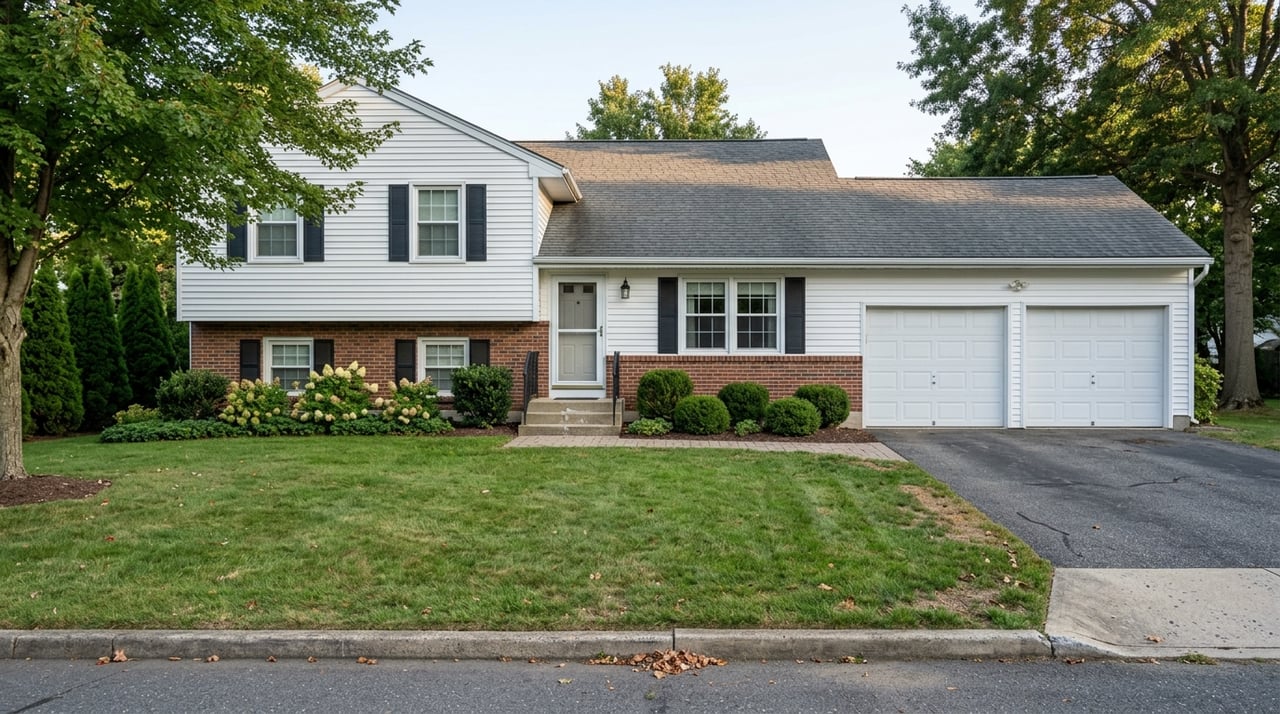
Split-level homes sit somewhere between a ranch and a full two-story home. They are designed with staggered half-floor levels, often with living areas on one level, bedrooms on another, and an attached garage built into the form.
This style became a common mid-century alternative to the ranch, especially from the 1950s into the 1970s. Compared with a ranch, a split-level often feels more dimensional from the street while still reading as practical and suburban.
Inside, split-level homes can give you more separation between spaces without requiring the footprint of a larger two-story house. That can work well if you like defined zones for living, sleeping, or recreation.
The tradeoff is usually complexity. More stairs and level changes can make the home feel less simple than a ranch, even if the layout uses the lot efficiently.
Who may like a split-level home
A split-level may be a good fit if you want:
- Distinct zones between living spaces
- A mid-century suburban layout
- More dimension than a ranch exterior
- Efficient use of a smaller or varied lot
How to compare home styles
When you tour homes in Hamilton Township, style labels are only the starting point. Many homes, especially mid-century ones, borrow features from more than one design tradition. You may see a ranch with colonial details or a split-level with a more traditional front appearance.
A better approach is to compare how each home works for your daily life. In this market, the most useful questions are often about stairs, lot setting, maintenance, and how formal or relaxed you want the home to feel.
Ask these questions as you compare homes
- How many stairs do you want to use every day?
- Do you prefer a formal or casual exterior look?
- How much exterior detail are you comfortable maintaining?
- Do you want compact space or more separation between rooms?
- How important is lot size and surrounding land to your decision?
What buyers should notice in Hamilton Township
Because Hamilton Township includes both established neighborhoods and a broad land area, it helps to look beyond the style name on the listing. The lot, setbacks, and surrounding setting may shape your experience just as much as the floor plan.
That is especially relevant in a township where protected land and Pinelands-related considerations can affect how properties feel and function. A ranch on a larger lot, a Cape Cod in an established section, or a colonial in a later-built subdivision can each offer a very different day-to-day experience.
It also helps to remember the local pricing context. In 2023, the median value of owner-occupied homes in Hamilton Township was $240,500, and 97% of reported owner-occupied homes were valued below $500,000. For many buyers, that means comparing value through layout, condition, and maintenance profile rather than chasing a style label alone.
Choosing the right fit for your lifestyle
There is no single best home style in Hamilton Township. The right choice depends on how you live, how much upkeep you want to take on, and what kind of layout feels comfortable for you.
If you want one-level living, a ranch may be the easiest match. If you love classic symmetry, a colonial may stand out. If you want compact charm, a Cape Cod could make sense. If you like separated spaces and a practical mid-century layout, a split-level may be worth a closer look.
The key is to focus on how the home works for you, not just what the style is called. That is often the smartest way to buy in a market with a broad mix of housing ages and suburban home types.
If you are thinking about buying or selling in Hamilton Township, working with a local team can help you sort past style labels and focus on value, function, and fit. Carla Z Campanella can help you understand the local market, compare home types, and make a confident move.
FAQs
What home styles are common in Hamilton Township, Atlantic County?
- Buyers in Hamilton Township are likely to see a mix of detached single-family homes, especially ranches, split-levels, Cape Cods, and colonial-style homes, reflecting the township’s large share of pre-1980 housing and later suburban development.
What is a ranch home in Hamilton Township?
- A ranch home is generally a one-story house with a low-pitched roof, broad horizontal shape, and often an attached garage, and it can be a practical option if you want fewer stairs.
What is a split-level home in Hamilton Township?
- A split-level home has staggered half-floor levels that separate living areas across different levels, often creating distinct zones without the footprint of a full two-story house.
What is a Cape Cod home in Hamilton Township?
- A Cape Cod home is usually a compact one- to one-and-a-half-story house with a steep roof, simple rectangular footprint, and modest traditional appearance.
What is a colonial-style home in Hamilton Township?
- A colonial-style home typically features a balanced, symmetrical exterior with evenly spaced windows, a centered entrance, and a more formal traditional look.
How should buyers compare Hamilton Township home styles?
- The best way to compare styles is to look at daily function, including stairs, room separation, maintenance needs, exterior detail, and lot setting, instead of relying on the style name alone.
